
Pricing Pottery
Ask ten different potters how to price your work, and you’ll get ten different answers.
If you search online for ways to price pottery, you’ll often see people talking about complex spreadsheets that include a whole bunch of stuff. It can make pricing seem pretty intimidating. We won’t do that here, BUT, know that there is a whole lot more that goes into pricing pottery than you might think. At first glance, a finished pot has a relatively straightforward cost in clay, glaze, and firing, but those expenses are only the beginning. A $50 mug does not contain $50 worth of clay and glaze.
How you approach pricing depends in part on a much bigger question: What do you need pottery to do for you? Are you a hobbyist looking to recoup some expenses so you can continue to make pots and have lots of fun? Are you hoping that pottery can provide some meaningful income on the side? Is making and selling art your full-time career? Where you fall along the spectrum does have some effect on what you need to consider or how you might think about pricing.
One Guild member, for example, described adjusting their prices primarily to keep up with costs of maintaining their practice:
“I don't usually have anything to sell over $45. I don't spend hours with drawing/painting and underglazing, so no really high prices. In the past few years, I have raised my prices a little to keep up with the cost of class fees, clay, glazes, tools, equipment.”
Another Guild member uses a more detailed formula:
“I use a formula to determine a minimum price that accounts for materials, hands-on time for a given piece, and overhead expenses. What I like about this approach is that it gives me a definitive objective number for a starting point - the minimum price to account for expenses and time. I emphasize ‘minimum’ because there may be expenses I missed, but from there I can consider other factors and make appropriate adjustments.”
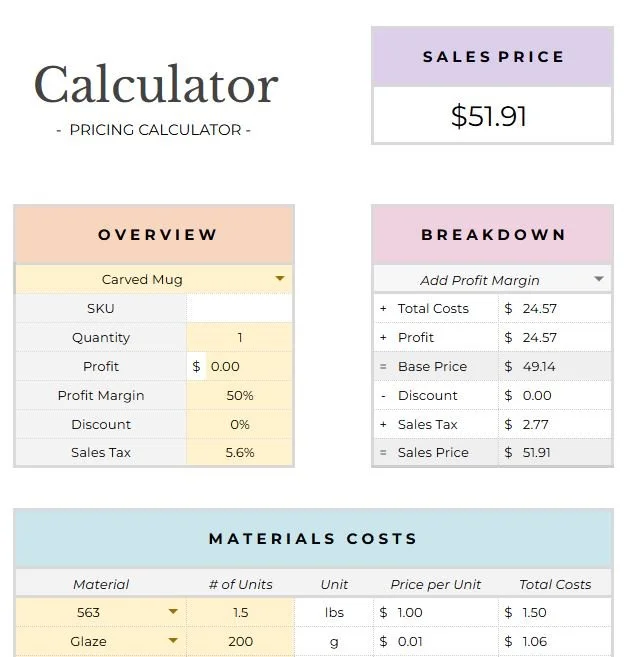
Neither approach is inherently better. Someone trying to pay for clay and classes just has different financial needs versus someone who is trying to support a full-time business. With that in mind, let’s talk about some of the things that can help you arrive at a price for your pots.
“So how long did this take you to make?”
Is probably one of the most frequently asked questions when selling pots. Many people assume pricing handmade work is something simple like:
(Material Cost x Amount of Material) + (Time x Wage) = Price
While material costs can be relatively straightforward to estimate, time is actually one of the strangest parts of pricing pottery. As one Guild member put it:
“I struggle with qualifying it in terms of $/hr because pottery involves so much active/waiting periods. I jump between projects and I’m terrible at accounting for my time. Sometimes I’ll spend days on something and then the glaze turns out terrible and I don’t even want to give it away. How do you account for those hours?”
Yes, how DO we account for those hours? I certainly stammer a bit when asked how long something took. Someone expects a simple answer, but once I start breaking down the process, I can see their eyes start to glaze over.
There’s another wrinkle to consider too: the better you get at pottery, the faster you often become. A beginning potter might throw six mugs in an hour while an experienced production potter can throw eighteen. That doesn’t mean the beginner’s mugs should cost three times as much. The experienced potter has spent years learning to make those eighteen mugs. Skill, consistency, efficiency, design development, and experience have value. You aren’t only accounting for the minutes it took to make the object today, but the experience that made those minutes possible. That’s one reason some potters don’t calculate an exact hourly wage at all.
“You never make dollar/hour on a piece of pottery. Pricing is a qualitative judgement based on relative time, complexity, and your target market. Also, Potters with a following can command a higher price.”
While yes, you can make a whole spreadsheet to track what your pricing should be, using qualitative judgement to approach pricing makes a lot of sense, so let’s get into some tips on how to do that.
What Does Similar Work Cost?
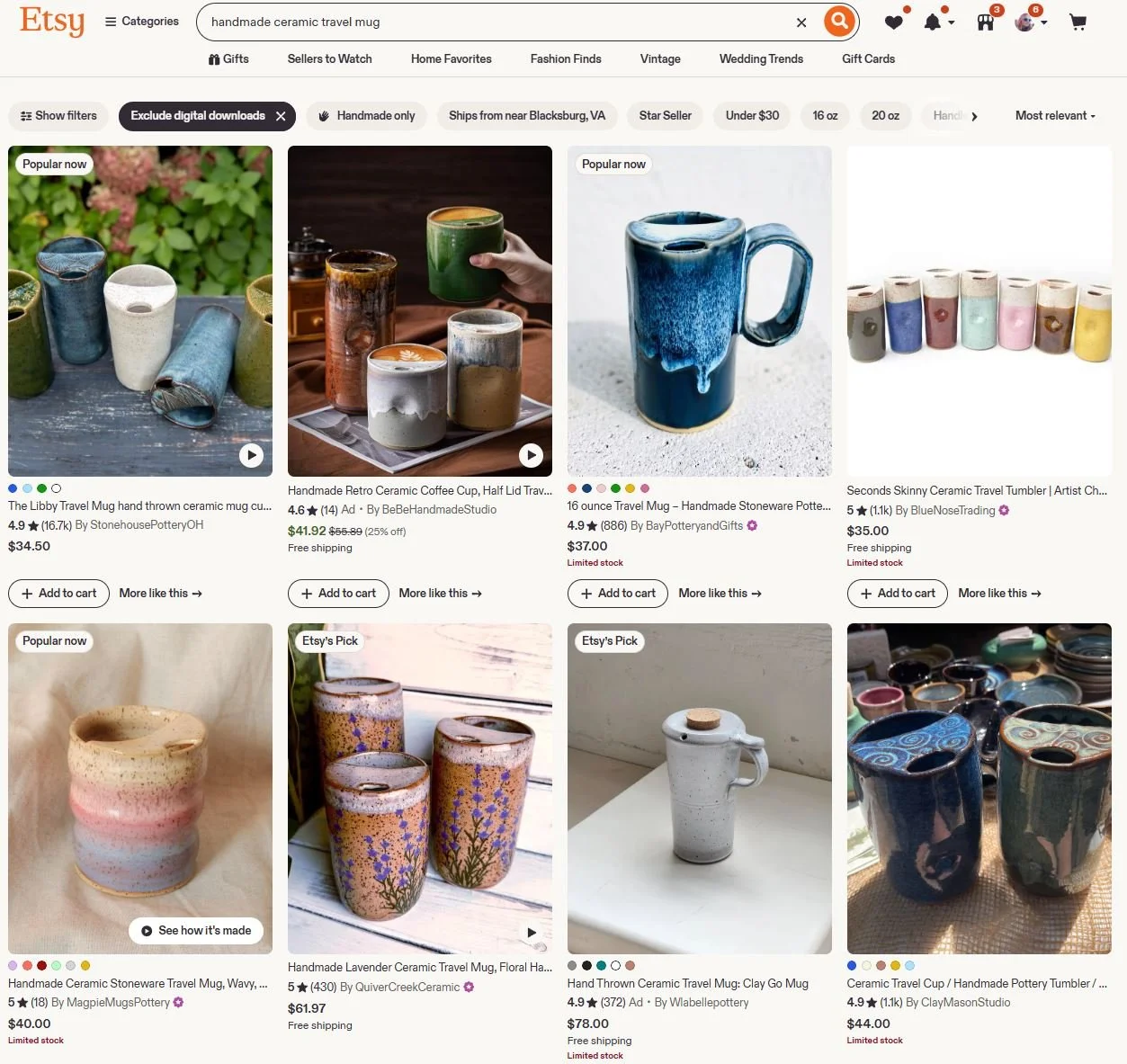
Once you have some idea of what you need from your prices, start looking outward. What does comparable handmade pottery sell for in your area or online? The key word here is comparable. I want to be really careful here - this isn’t about comparing ourselves to others and getting down about our work, or criticizing someone else’s. Think of it as basic market research. What are people selling stuff for, and where might your work fit in?
Don’t search for the cheapest handmade mug you can find. Look for work with a similar size, complexity, quality, level of decoration, and craftsmanship. Etsy can be really useful, but also look at local markets and galleries, and think about what you might have seen at previous Guild shows.
One Guild member described their approach as:
“My pricing tends to be a combination of material cost, time, complexity, and what feels appropriate for the finished piece. I also pay attention to what comparable handmade pottery is selling for, while trying not to let that completely dictate my pricing.”
Consider Where You're Selling
Customers attending a school or church craft fair may arrive with different expectations than customers attending an established art festival. Galleries, farmers markets, holiday markets, craft shows, and juried art festivals all attract somewhat different audiences. That doesn’t mean changing the price of the same mug from one event to another. Consistent pricing is a really good practice for yourself and importantly, for your customers. Instead of changing up your pricing, consider whether the work you bring fits the audience. A casual market may be a great place to bring more small, approachable pieces alongside your larger work. At a juried art show, customers may be more prepared for larger statement pieces and higher price points.
One Guild member offered a particularly useful way to think about this: make related work at several scales. You might have an eye-catching $100 vase, a $50 mug, and a $25 cup featuring the same surface design. A customer who loves the vase but can't afford it may be delighted to take home the cup.
This is helpful advice as you prepare for the upcoming Guild show, too. You are able to request labels that can easily cover a range of price points. With our show in particular because of how it functions with the shared checkout, it is especially important that you have the prices you need, as you won’t be able to change them up outside of the labels you requested.
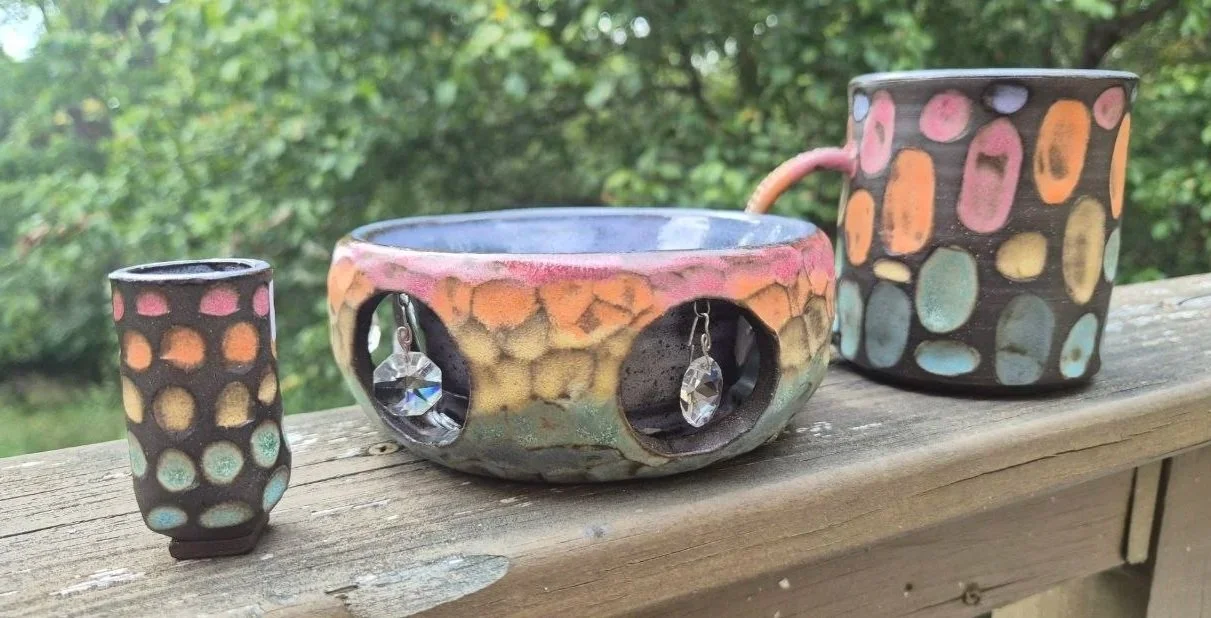
An example of three pieces with similar design elements that cover a range of pricing.
Experience-Based Pricing, aka Vibes Informed by Data
“I think ‘what is the least I am willing to part with this piece for? What is a great realistic price that I would love to get for it?’
Then depending on how much I love it, I put it somewhere between those two price points.”
♦♦♦
“There is nothing wrong with underpricing a particular piece if you want to get it out of your inventory for some reason. Also, it's not crazy to over-price a piece that you would be happy to hang on to. Both - within reason!”
Not every potter uses a formula. Several Guild members described pricing methods that combine experience, previous prices, size, complexity, market knowledge, and, eventually, a certain amount of gut instinct.
This isn't necessarily arbitrary pricing. Over time, experienced potters accumulate information. You learn what customers will pay, which forms sell consistently, how much additional effort different pieces require. Every time you sell pottery, you learn a little more. And remember, the price you choose today isn’t a permanent commitment. Pricing will evolve as your work, experience, expenses, and market change. Think back to your last event, or last year’s Guild show. What sold? What came home? What received a lot of attention? What would you like to do differently this year? I encourage you to take some notes!
It’s sometimes said that if you sell out immediately, your prices are too low, and if nothing sells, your prices are too high. There is some truth in that, but the reality is more complicated. One Guild member touched on that exact idea:
“I’ve often seen the point made that if you sell most or all of an item then you priced it too low, but for some items as long as I’ve covered my calculated minimum price I’d rather leave them at a price where most of it sells.”
After all, unsold inventory has a cost, too. You may need to pay for another show, spend another weekend selling, pack and transport the work again, or find a place to store it. Instead of treating selling out as an automatic signal to raise your prices, you can look for patterns and let your sales teach you.
A Few Common Pricing Traps
Undervaluing Work
This can be particularly difficult when you're new to selling. It is easy to price according to confidence rather than value:
I'm not as experienced as that potter, so my mug should cost half as much.
That is what we call “bad vibes”, but we are here to tell you that feeling half as confident doesn’t make your pottery worth half as much. Perhaps their mug is $50 and yours is a well-made $40 mug. Don’t undersell yourself!
“What would I pay for this?”
Yep, that’s another trap. As potters, we aren't necessarily our own customers. We can make the thing! Our own spending habits aren't always a reliable measure of what another customer values, more often than not this is tied to undervaluing our work.
Me: "No one will buy my mug at $60.”

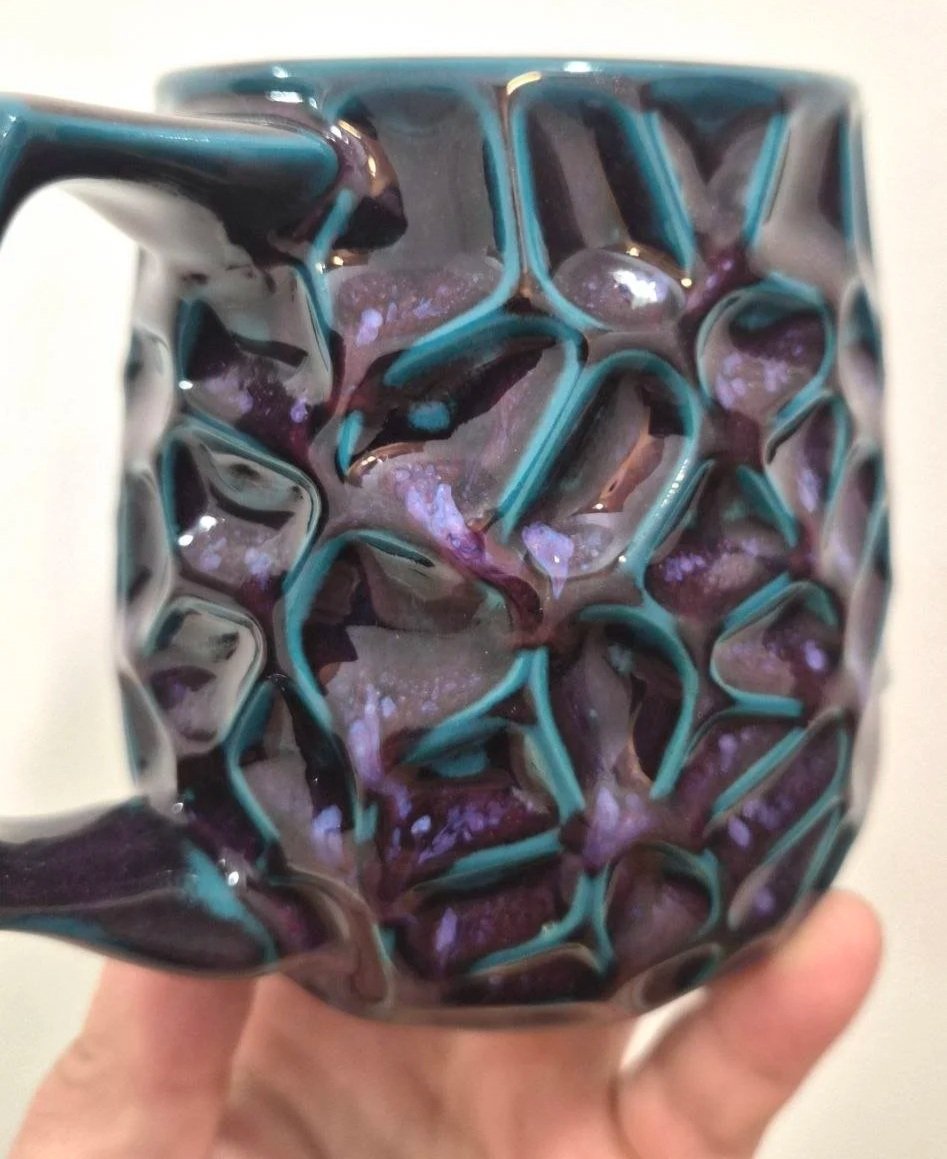
The mug - made by Hammerly Ceramics
Also Me: Purchases a mug for $100 because I REALLY wanted it and love the artist.

This isn’t an argument for making your mugs as expensive as possible. It simply demonstrates that what you would normally spend isn’t necessarily what someone else is willing to spend on the work they connect with. One Guild member put it particularly well:
“I’ve had to remind myself that I’m not necessarily my own customer. Something feeling expensive to me doesn’t automatically mean it’s overpriced. My biggest advice would probably be not to undervalue your work just because you enjoy making it. There is a lot of time, skill, equipment and expense behind handmade pottery that the customer never sees.”
“It’s just a hobby.”
There is also a community component to pricing, particularly when potters with different levels of experience and different financial goals are selling alongside one another. If pottery is a hobby, you may not need your work to pay a salary, or support all the expenses of running a business. That gives you flexibility, but it doesn’t necessarily mean your work should be substantially cheaper simply because you don’t depend on the income.
Some potters worry that dramatically underpricing handmade work can influence what customers expect pottery to cost, particularly when a customer is new to buying handmade ceramics. At the same time, price is only one part of why someone chooses a pot. Customers also respond to craftsmanship, design, the maker's individual style, and simply falling in love with a particular piece.
For the BRPG show, the goal certainly isn't for everyone at the show to charge the same amount, or a high amount. It would be impossible anyways because our membership represents a wonderful mix of experience, styles, and approaches to pottery. What we do encourage is making your price an intentional reflection of the work you’re selling rather than setting it artificially low because you're new, because pottery is "just a hobby," or because you don't personally need the income.
Last thoughts to consider before the price tag goes on… the gut check
Consistency: Do similar pieces have similar prices? If two mugs differ by $15, can a customer understand why?
Relative value: Does a large serving bowl appropriately cost more than a cereal bowl? Does extensive carving, painting, or decoration show up somewhere in the price?
Market: Is your price reasonably aligned with comparable handmade pottery?
Sustainability: If every piece sold at this price, would you be happy about it, or would some part of you wish you hadn't sold it?
Repeatability: Could you make another one and happily sell it for the same amount?
Your goals: Most importantly, does this price accomplish what you need pottery to accomplish for you?
Maybe selling your work buys your next bag of clay. Maybe it pays for your classes and Guild membership. Maybe it provides meaningful income alongside another career. Maybe it pays your mortgage. Those are different goals, so it makes sense that we don't all arrive at our prices in exactly the same way.
After all, ask ten potters how to price their work, and you'll get ten different answers.
As always, thanks for reading –
Stephanie and Zenah
P.S. If you're reading this and getting ready for the Guild show, pricing is only part of the equation. How work is displayed and presented can have a surprising effect on how customers perceive it. We'll tackle displays, presentation, and getting your booth ready for a show in next month's blog post.